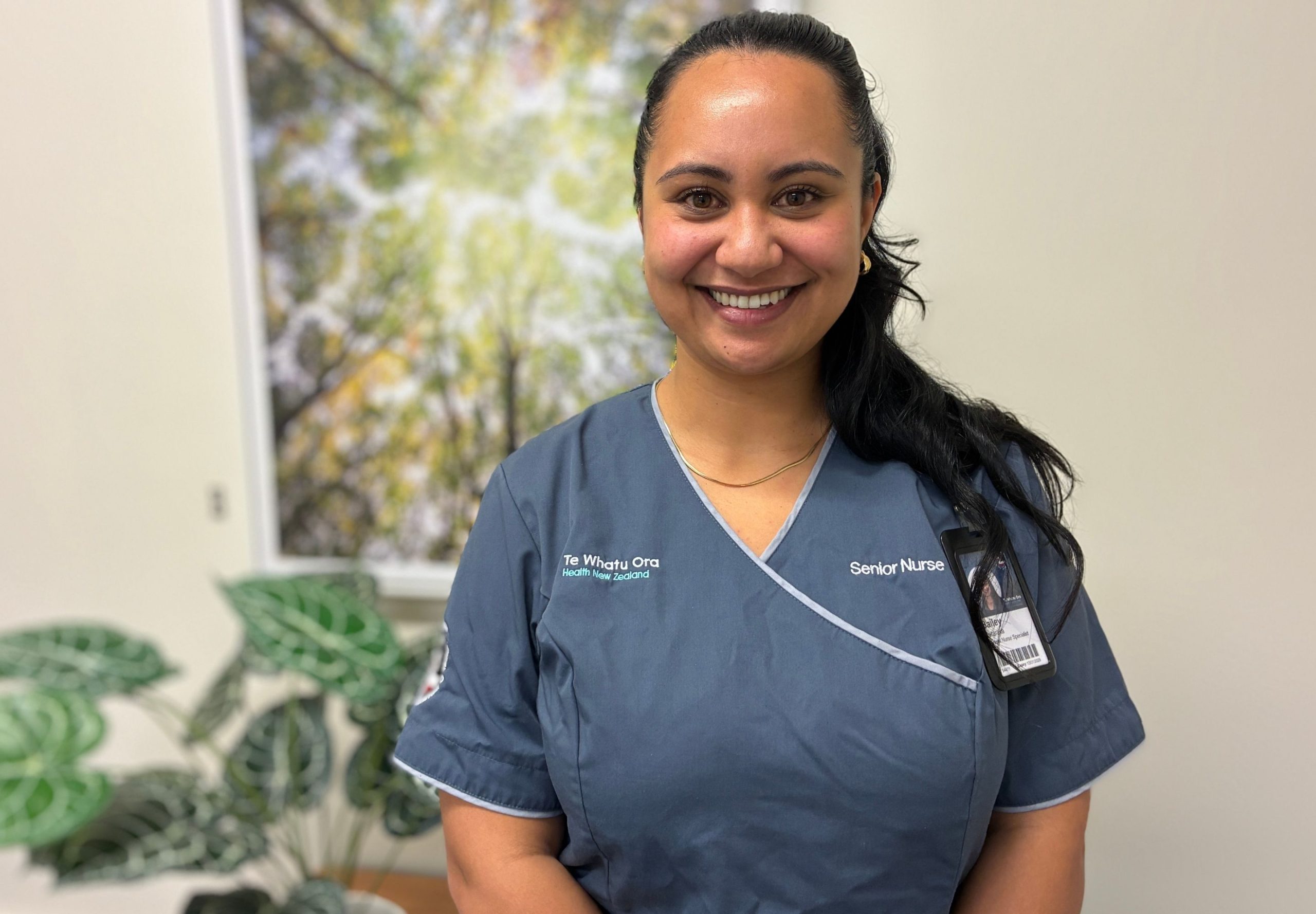
We sat down with Bailey Hetaraka, Kaiārahi Nāhi | Māori Nurse Specialist at Auckland City Hospital and Rise scholarship recipient, to hear about her journey into nursing and the role she was made for.
Can you introduce yourself and tell us a bit about your background?
Kia ora, my name is Bailey. I am a registered nurse based here at Te Toka Tumai, Auckland Hospital. I am currently working in the Kaiārahi Nāhi team as a Māori Clinical Nurse Specialist. He uri ahau nō Ngati Tai, Ngati Maniapoto me Ngati Awa.
I started out as a new grad here in Ward 77 – orthopaedics. Much of my student training was also based here, including placements in Ward 78 (General Surgery & Trauma), and the Starship Child & Family Unit (Haumaru Ōrite). I completed my pre-registration placement in the Adult Emergency Department (ED) and Clinical Decision Unit (CDU).
As a student, I wasn’t entirely sure where I would end up, but I have always been passionate about Māori health and improving health outcomes. Naturally, that passion has led me into a Māori health role, and it has been incredibly rewarding. It feels like everything has aligned the way it was meant to.
What does your role involve?
My primary role is to support Māori patients on the surgical planned care pathway. We support patients from across the country who are referred to Auckland for surgery and first specialist assessments (FSA).
The Kaiārahi Nāhi team is made up of ten Māori nurse specialists. Our service supports Māori through clinical navigation, advocacy, and partnership. We work to remove barriers, guide whānau through complex health systems, and ensure timely access to care.
Our role extends beyond the inpatient setting – we also work within outpatient clinics and the community. For example, we may attend anaesthetic assessments alongside whānau to ensure they have a clear understanding of their surgery, potential risks, and post-operative care.
In simple terms, you can think of us as “Google Maps” for Māori patients – guiding their journey through the healthcare system while working to improve their overall experience and health outcomes.
What does a typical week look like?
Our days can vary, as we work on a rotating roster. This month, I am on referrals and home visits. Some days are spent out in the community and other days are based on the ward or supporting patients at Greenlane Clinic. The role can be admin-heavy sometimes, with many phone calls, meetings, and follow-ups. We cover a wide range of services, including Orthopaedics, Cardiology, Urology, Gynaecology and Ophthalmology.
Why did you choose nursing as your career path?
In 2019, I lost my cousin Amelia. She had received a heart transplant, and although the surgery was successful, her body later rejected the organ, and she went into complete organ failure. She was only 12 years old.
Losing my cousin was a traumatising experience, but it was the love and care shown by the Starship nurses during that time that deeply imprinted something in me.
I felt inspired to do something more meaningful with my life and now six years on, I’m grateful to be in a position where I am doing exactly that.
What were some of the highlights of your trainingā
I studied at Unitec and had a really positive experience as a student. One of the aspects of my training I valued most was the opportunity to work across a range of clinical settings. Clinical placements gave me a well-rounded understanding of nursing and helped me build confidence in different environments. Nursing is such a diverse pathway, with so many specialties and opportunities. As a student, it can be challenging to know where you want to begin, without experiencing those areas first-hand.
The highlight for me, both as a student and as a nurse, has always been connecting with patients and their whānau. You meet people from all walks of life, and it’s a privilege to be part of their journey.
There is a deep sense of honour in the mahi we do as nurses – it’s more than just a job, it’s a calling. Supporting people through vulnerable and often traumatic moments isn’t always easy, but it is incredibly meaningful and rewarding.
What's been the most challenging part of your journey?
The transition from being a student to a registered nurse was hard. Nothing truly prepares you for the weight and responsibility of our role. I experienced burnout during my new grad year. I was working full-time, often doing four 12-hour shifts in a week, rotating between days and nights. Adjusting to shift work, navigating short-staffing, and taking on the responsibility of caring for others while learning how to be a nurse were very challenging. They say the first year is the hardest ,and they weren’t lying. The nature of our work isn’t always easy for others to understand, and there is a certain heaviness and emotional weight that comes with being in healthcare. At one point, I even questioned whether this was the right path for me.
What made the difference was the support from the Ward 77 team. Their unwavering support, encouragement, and guidance carried me through that period and built my confidence as a nurse. I also want to acknowledge the unconditional love and support of my partner, my mum, my whānau, and my friends. It truly does take a village, and I am immensely grateful to have a strong support system behind me.
Is there a moment when you felt the scholarship really made an impact?
The scholarship gave me the opportunity to focus entirely on my studies and placements without the added stress of financial pressure.
Not having to work meant I could fully commit to my learning, be present in my placements, and get the most out of every experience.
What would you say to a student thinking about applying for the Rise Scholarship?
Go for it. I’m really grateful that I took the leap and applied, it made a huge difference to my experience as a student. I don’t think I would have had the same level of support without it. Studying can be challenging, so I’d encourage anyone to take up opportunities like this when they’re available.
What would you like to say to the donors who support the Rise scholarship programme?
Receiving the Rise scholarship made a really meaningful difference in my journey. Nursing is such a demanding degree, and having the financial support took away a lot of pressure.
But beyond the financial side, it also felt like someone believed in me. Knowing that people I've never met were willing to invest in my future was motivation in itself. It pushed me to work harder and really make the most of the opportunity I'd been given.
Now, working as a registered nurse, I'm living proof of that support. I put a lot of heart into my practice. I work as my best self, I care for my patients with compassion and respect, and I contribute meaningfully to my team.
I'd like to acknowledge and thank those who have donated. Your contribution doesn't just support a student in the moment – it carries through into the care we provide, the patients we support, and the communities we serve. I'm really proud of how far I've come, and your support has been a huge part of that. Ngā mihi nui ki a koutou.
Watch Bailey's message of thanks here >
Rise scholarships support aspiring nurses and midwives to overcome challenges they face while training. To find out more or support the programme, click here.
You can help our hospital help you.
Your support will help Auckland City Hospital’s teams do even more for patients and whānau in their care, beyond what government funding can provide.