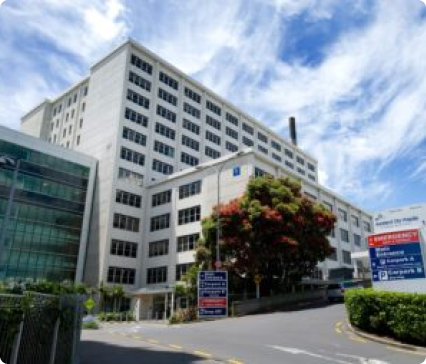
A newly funded study led by oncologists at Auckland City Hospital will test a novel model for running clinical trials, with the aim of helping New Zealand cancer patients access trials no matter where they live.

Everything we do in oncology has come from previous clinical trial results. For some people, clinical trials can give them access to medicines they wouldn’t otherwise be able to afford or have access to. – Dr Michelle Wilson
As published in HRC NZ on 27 June 2024:
The Health Research Council of New Zealand (HRC) announced funding for this study today as part of its 2024 Project and Programme funding rounds, awarding 26 grants worth a combined total of $50.34 million.
These grants are designed to support excellent research ideas with strong potential for impact, innovation and improving health outcomes. They sit alongside the HRC’s other investments, which include support for research that directly informs healthcare policies, and funding to develop critical health research skills and expertise in New Zealand.
Auckland City Hospital and University of Auckland oncologists Dr Michelle Wilson and Dr Nicola Lawrence are co-leading this study to increase patients’ access to cancer clinical trials throughout New Zealand with a highly experienced team of medical oncologists and researchers.
The team will use an ongoing clinical trial (Cancer Molecular Screening and Therapeutics or MoST) at Auckland City Hospital that offers genomic (DNA) testing for patients with rare cancers as the basis for the study.
Even though these cancers have been classified as rare, collectively, Dr Wilson says they make up a significant – and increasing – burden of disease across the country. Using a decentralised clinical trial model, the team will expand the trial to include patients in Northland and Canterbury to ensure the model works for both small and large sites covering large population areas with wide geographical spread.
“Clinical trials traditionally involve patients and their wh?nau having to attend hospitals in-person with trial staff. This can be a significant social, financial and time barrier for those who live outside of major regional cancer centres – which is more than 35 percent of New Zealand’s population – with many patients having to leave their family and support network, take time off work, and pay to travel to the trial site,” says Dr Wilson.
International guidelines recommend that participation in clinical trials is considered part of standard management as it can be the best treatment option for many cancer patients. However, despite this, very few patients have access to clinical trials in New Zealand, with smaller hospitals and rural areas having almost no patients enrolled on clinical trials.
“Everything we do in oncology has come from previous clinical trial results. For some people, clinical trials can give them access to medicines they wouldn’t otherwise be able to afford or have access to. For others, it may provide different treatment options with better tolerability but same efficacy. Clinical trials do not guarantee benefit, but they help us find the best options to enable people to live longer and better,” says Dr Wilson.
The decentralised clinical trial model the research team are testing will take the trial to the patient, with trial activities performed at patients’ homes and/or at local healthcare facilities with the oncology team they are familiar with. The primary trial site – in this case, Auckland City Hospital – will work collaboratively with the smaller ‘satellite’ sites in Northland and Canterbury to enrol, consent and treat patients for the trial. Remote monitoring and data collection via telehealth and testing using local laboratories will reduce logistical difficulties in accessing the trial location.
This model has been successfully used across Australia, Canada and the UK to increase access to clinical trials at rural and remote sites.
“One of the challenges with the majority of cancer clinical trials is that they only recruit one or two patients from different sites. Thanks to this funding, we’ll be able to recruit 150 participants to the MoST clinical trial from Northland and Canterbury over three years without them having to travel to Auckland. This will help us enormously to work out how we can make this model work best for patients nationally.”
“Ultimately, our goal is to reduce the burden for cancer patients and their wh?nau, increase enrolment and retention in clinical trials, particularly for those currently underrepresented, and to preserve quality of life,” says Dr Wilson.
HRC Chief Executive Professor Sunny Collings says increasing New Zealanders access to cancer clinical trials is a potential win-win for both patients and clinicians.
“If the decentralised clinical model developed through this study proves successful, the pathways and processes developed could be applicable to any area of medicine.”
“Another potential advantage of this model is the opportunity it gives clinicians in smaller centres, who don’t have access to research infrastructure, to engage in research and create networks across New Zealand,” says Professor Collings.
You can help our hospital help you.
Your support will help Auckland City Hospital’s teams do even more for patients and whānau in their care, beyond what government funding can provide.